The Atomic Design of Improvisation

I'm also a musician!
- I play the saxophone, flute, and clarinet professionally, and handful of other instruments in various capacities.
- I've played with some artists that you probably know: The Temptations (twice!), Johnny Mathis, Liv Warfield, The OJ's, Kamasi Washington, and many others!
- I have an album coming out later this year of all original music, stay tuned!
What is this ⚡️ talk about?
What is this ⚡️ talk about?
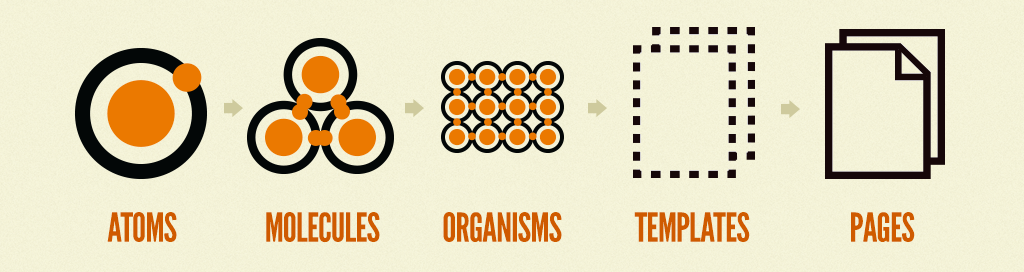
- What is Atomic Design?
- What is improvisation?
- How can improvisation be approached from an atomic perspective?
A presentation on music without an instrument?
I'm really not prepared
What is improvisation?
A spontaneous musical expression that is created "on the spot".
- Usually in a collaborative environment (with other musicians, artists, dancers, performers).
- Often within the boundaries of a song, tune, or harmonic structure (but not all the time).
- Not just "making stuff up".
Jazz improvisation is built around a universally understood language and repetitive set of improvisational concepts.
"The Lick"
Enter, Atomic Improvisation
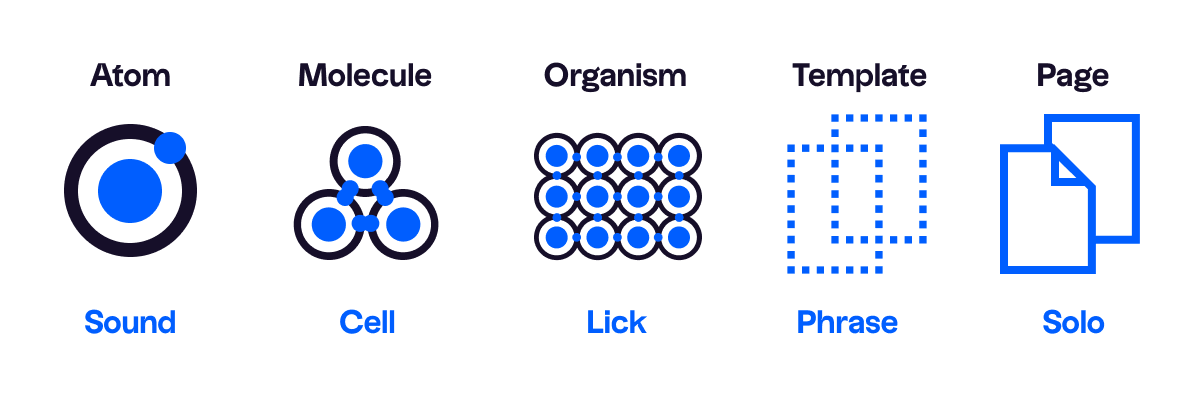
How can we break down improvisation in a similar fashion?
- Sounds: The relationship between two notes or pitches, considering the intervalic relationship between them.
- Cells: The combination of multiple sounds, generally between 2 and 6.
- Motifs: a.k.a. licks, comprised of multiple cells and sometimes sounds. Motifs are generally applicable in the context of a harmonic sequence or chord progression.
- Phrases: Comprised of multiple motifs and licks, over a longer and more complex chord progression.
- Solo: The end result comprised of multiple phrases, licks, motifs, cells, and sounds.
What does this look like in practice?
Let's break it down
Identify the sounds
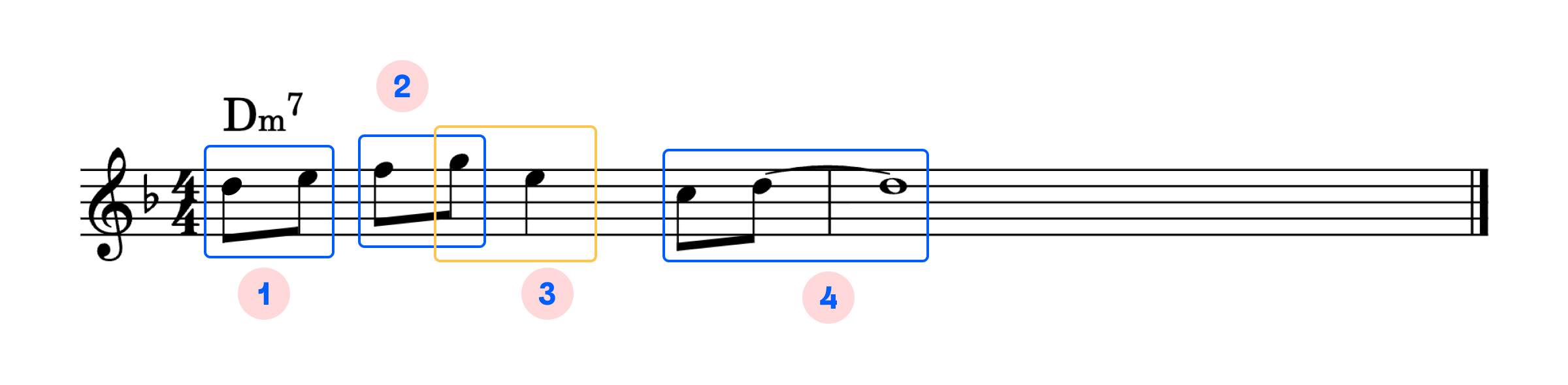
- 1: Major 2nd, ascending
- 2: Major 2nd, ascending
- 3: Minor 3rd, descending
- 4: Major 2nd, ascending
This could also be analyzed as this:

- 1: Minor 2nd, ascending
- 2: Major 3nd, descending
Identify the cells

- 1: 4-note digital pattern
- 2: Enclosure of the root scale degree
Now we have a motif!

🎉
Assembling a solo
Analyze the solo

This solo contains cells, motifs, and phrases centered around:
- Digital patterns
- Enclosure focusing on harmonic minor
- Enclosure leading with the altered scale
- Motivic development
- Sequencing
- Change running
- And many more!
Why is this important?
Learning to improvise is hard!
Breaking down improvisation into more easily digestible chunks can help students to more easily conceptualize not just what notes they should play when they improvise, but why they should play them.
More akin to speaking a language
When we learn a new language, we spend a lot of time learning words and phrases in context, rather than randomly combining letters and words into a sequence (in some cases how jazz improvisation is taught).
In conclusion
Everything in life can be broken down and in an atomic fashion to help with comprehension, organization, learning, and deep conceptual understanding.
Now
I need to open a pull request to pick up my dry cleaning on the way home.